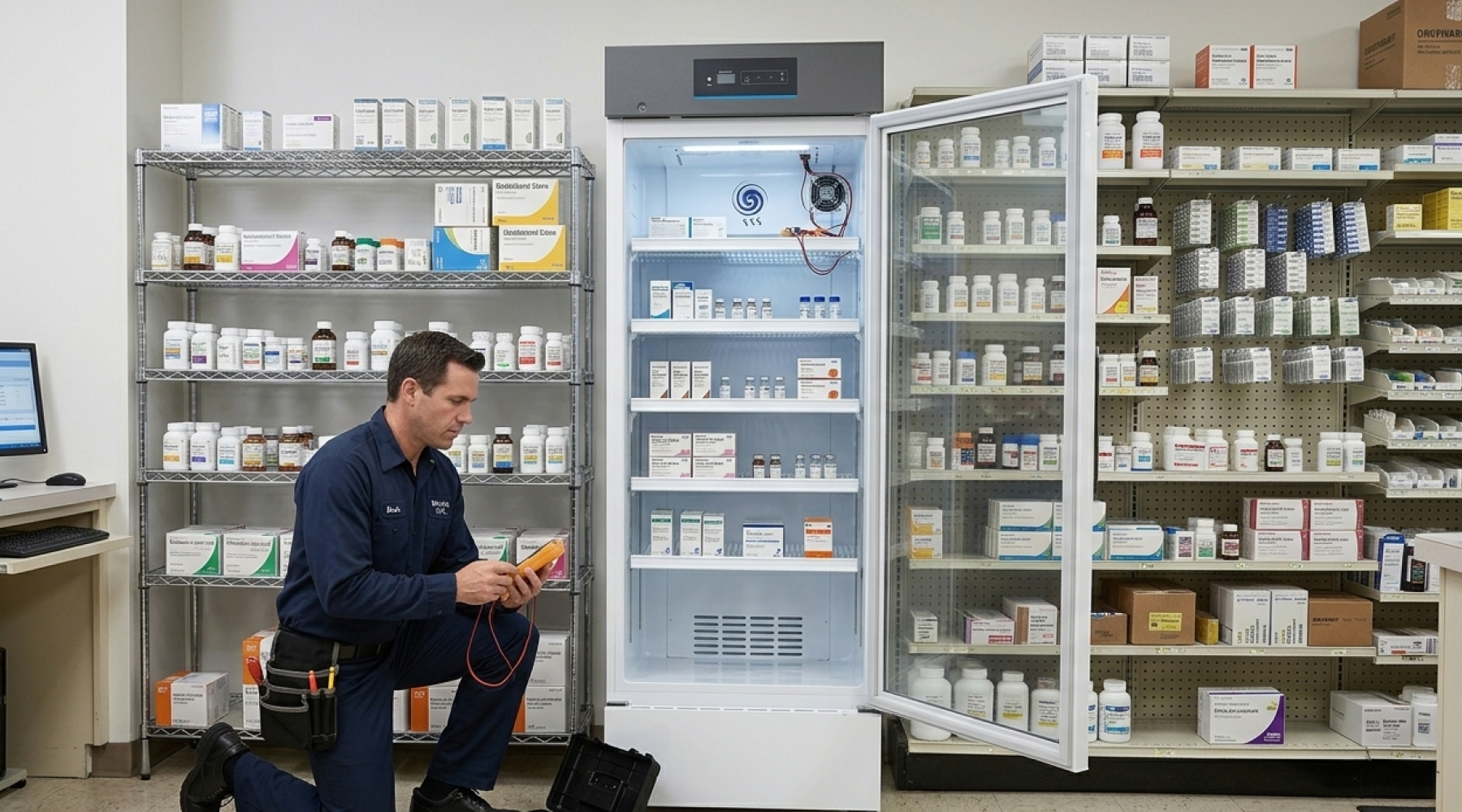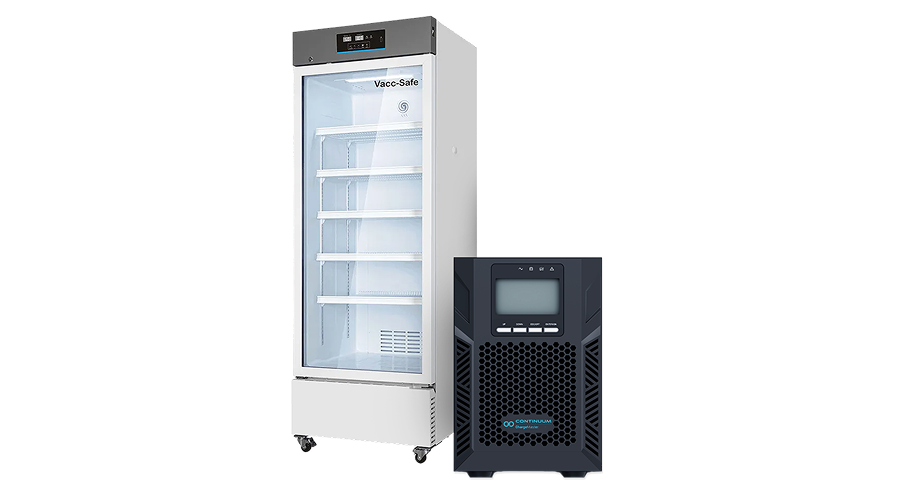
An Uninterruptible Power Supply (UPS) is a critical component for medical refrigerators, providing valuable backup power to keep vaccines safe. When a power outage occurs, vaccine refrigerators can only maintain their temperature for 30-40 minutes, making a UPS system vital for providing a continuous source of power. This is important because even brief temperature excursions outside the required range can compromise vaccine potency, with just a single outage having the potential to ruin the entire stock.
UPS systems can come in various types, each with its own characteristics, from offline and line-interactive systems to online double-conversion units, with a range of kVA sizes and installation options to suit different facilities. Our article gives you a complete guide to UPS systems for vaccine refrigerators, including the key factors to consider when choosing the right one for your medical facility.
What is a UPS and How Does It Work?
UPS systems are important components for medical facilities with vaccine refrigerators that help to ensure their safe storage through any power interruptions. It essentially operates as a battery backup system, responsible for providing short-term power to connected equipment when there is no mains electricity. When a power failure occurs, the UPS is responsible for switching the load over to its batteries to maintain a continuous supply of power to refrigerators, to prevent these interruptions from affecting the storage conditions of vaccines.
In addition, many UPS systems can also help to regulate incoming power to acceptable parameters, preventing any power surges or voltage spikes from damaging the connected equipment. Depending on your UPS type, it can help to maintain a stable voltage output, which is typically between 220 and 240 V, at all times, regardless of the amount of input power.
Why is a UPS important?
A UPS system can be an essential component to any healthcare environment for the following reasons:
Protects against cold chain breach
Based on the Australian Government’s National Vaccine Storage Guidelines, all vaccines must be stored at the safe temperature range of +2°C to +8°C at all times. When temperatures move beyond this range, often due to a loss of power, a cold chain breach would have occurred. Therefore, because a UPS system can keep your refrigerator connected to the power supply, it can help to keep temperatures stable, even through emergency situations.
Helps to prevent any costly losses
Stored vaccines can be worth thousands of dollars, and just a single power outage can lead to significant financial losses and insurance claims. A UPS that helps to prevent cold chain breaches from impacting your vaccines can help to prevent your facility from accruing costly losses.
Ensures patient safety
Because vaccines are delicate biological products, they need to be stored in medical refrigerators to maintain their potency and efficacy. A UPS can therefore help protect patient safety by supporting refrigeration systems and ensuring vaccine efficacy.
Reduces the need for emergency relocation
Backup protocols during emergencies may require your vaccines to be transported and stored outside their usual refrigerator. This can be expensive and may pose a significant logistical challenge for medical facilities. With a UPS system keeping your refrigerator running, this can reduce the need for another facility or expensive transportation.
Regulatory and Compliance Considerations
To ensure vaccines remain safe within storage, particularly through any emergencies or power outages, it’s recommended that your refrigerators are fitted with a UPS. They are also essential for medical facilities to remain compliant with the standards laid out by the Australian government within their National Vaccine Storage Guidelines – Strive for 5.
The guidelines state explicitly that “vaccines must always be stored and transported within the recommended temperature range of +2°C to +8°C, to store vaccines at +5°C.” It also states that in the event of a power outage, it’s recommended that facilities investigate backup power supply options, such as an uninterrupted power supply or generator. Although it doesn’t directly state that it’s a necessary addition, a UPS remains one of the best protections against a cold chain breach, and keeping vaccines within their required +2°C to +8°C range.
As stated in the Strive for 5, breaches that are beyond the recommended +2°C to +8°C must be reported straight to your state or territory health department. A failure to make these reports, or any instances where your facility was found to have mishandled vaccines, could result in legal action from the Australian Health Practitioner Regulation Agency (AHPRA). Furthermore, patients who received mishandled vaccines can also lodge legal claims against professionals. This makes the role of a UPS vital to keeping your vaccines safe and your facility removed from any legal action.
Types of UPS for Vaccine Fridge
A UPS system can come in several different types for vaccine refrigerators, each with its own unique characteristics:
Offline UPS
An offline UPS is the most basic option, providing a low level of protection against any power outages, surges and spikes. Although it’s the most cost-effective choice, we don’t recommend its use on vaccine fridges or other medical equipment. It’s more commonly used on smaller pieces of equipment that don’t have a critical need for temperature consistency, such as home office equipment, workstations and computers.
Line-interactive UPS
A line-interactive system is the next level up from an offline UPS, providing a higher amount of protection. Although it still operates as a basic battery backup, it can be used for medical equipment. It’s line-interactive, meaning that while power is detected, it both charges the battery while transferring power to the vaccine fridge it’s connected to. However, when a power loss is detected, it automatically transfers over to the system’s backup batteries. It’s worth noting that this continuous charge-discahrge cycle may reduce the lifespan of your battery over time. A line-interactive UPS can be great for managing power failures, surges or spikes, although the battery may need to be replaced more frequently than other UPS types.
Online double-conversion UPS
When it comes to medical UPS systems, an online double-conversion provides the strongest level of protection and is the recommended type for vaccine fridges. It is the ideal choice because it can provide a seamless supply of power to any medical equipment by converting power from AC to DC and back again without any interruptions. Although it’s the most expensive option, this system provides the maximum amount of protection against any power outages. It offers an instantaneous switchover to battery power that makes it indispensable for medical facilities.
Vacc-Safe offers a comprehensive range of UPS systems designed specifically for vaccine refrigerators. There are three models available, each offering progressively longer runtimes to match the demands of your facility.
For benchtop units up to 150L, the VSC-2KVA-18 delivers a 24-hour runtime, while the VSC-2KVA-30 provides up to 16 hours for larger units. Pricing starts at $1,300 for the VSC-2KVA-6, while the VSC-2KVA-30 starts at $3,100.
Built-in UPS
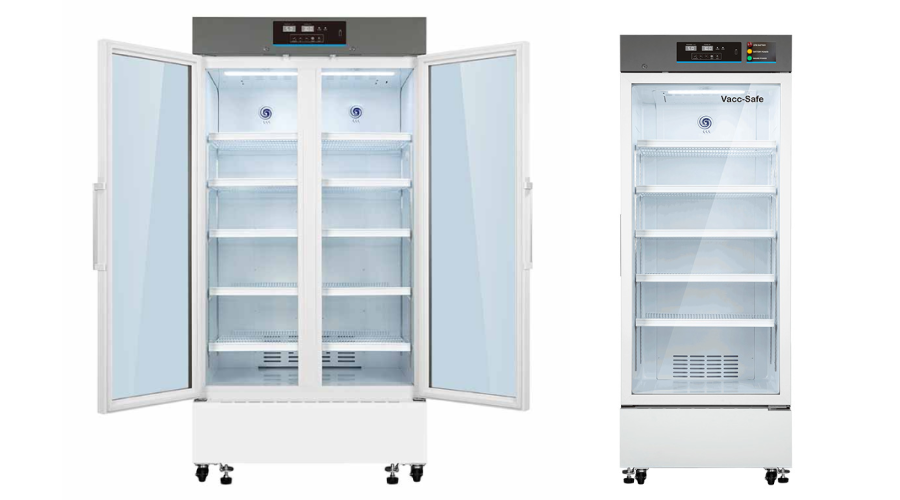
The Vacc-Safe PowerGuard is a brand new technology, a QCPP-approved vaccine refrigerator with a built-in UPS, the first of its kind globally. Instead of a bulky UPS box, the Vacc-Safe PowerGuard delivers a reliable, continuous supply of power in a space-saving design.
Features and Specifications
- 2-8°C Pharmacy Refrigerator
- Precise temperature control within +/- 1 degree variance
- Integrated UPS battery backup
- All units have a minimum 8-hour run-time option
- Battery type: Lithium (LifePO4) or Valve-regulated Lead Acid (VRLA)
- Space saving; eliminates bulky boxes
For more information on these systems, please visit their product page here.
How to Choose a UPS for a Vaccine Fridge
Choosing the right UPS system will be essential for keeping your vaccine safe and your refrigerator running as intended. To find the perfect UPS, consider the following factors:
Power capacity
Your UPS should be capable of providing enough power to the refrigerator to keep it running through any power outages. To help you determine this figure, consider the power consumption, or wattage, of the vaccine refrigerator. The larger the fridge, the higher the wattage, and we recommend a UPS system with a watt output that’s around 20 to 30 per cent higher than the device it’s protecting. The amount of units running off a single UPS is also a factor, as each additional refrigerator will increase the total load and power capacity required.
Runtime
This refers to the length of time a UPS can deliver a continuous supply of electricity to your refrigerator during a power outage. Therefore, you will need to ensure your UPS has sufficient power and runtime capabilities to provide power for the duration of a power outage. Your UPS’s runtime will largely depend on the size of your vaccine refrigerator and the length of an outage.
Lifespan
Consider the life expectancy of your UPS and the internal battery in general. Try to prioritise modern battery technologies that can achieve a longer lifespan, such as Lithium Iron Phosphate (LiFePO4). Typically, you should expect these batteries to last between 7 to 10 years.
Power issues
When choosing a UPS, think about your location and whether you experience frequent power outages or surges. If this is a frequent occurrence, consider choosing a UPS with a larger battery capacity to account for it.
Alarm and monitoring
Your vaccine refrigerators should be fitted with alarms and monitoring devices such as thermometers and data loggers, to help alert professionals if the internal temperatures move beyond the safe range. Your UPS should be able to integrate and power both your alarms and monitoring devices.
Size and weight
It will be important to choose a UPS system with a size and weight that’s appropriate for the space in which it will be installed. For example, if you have limited space, choose a refrigerator with a built-in UPS backup system such as the Vacc-Safe PowerGuard.
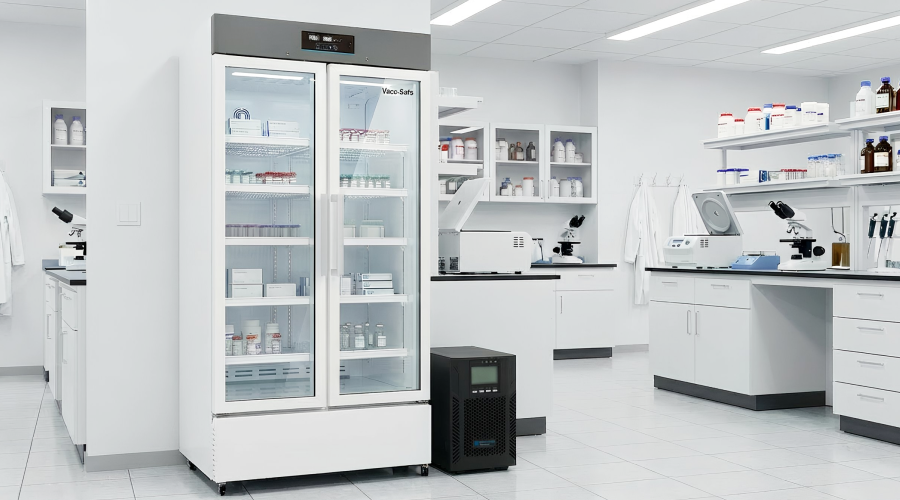
Vacc-Safe offers a broad range of UPS systems designed specifically for vaccine refrigerators. We have tested and provided the ideal UPS pairings to suit any refrigerator, from compact benchtop units to large double-door fridges. For more information on UPS systems or how to choose the right one for your refrigerator, please contact the experts at Vacc-Safe.